


 +38 068 277 99 23



Since the moment humans learned to keep bees, beekeepers have been studying their behavior and inventing new hive designs to improve honey production. Today, there are dozens of types of «bee houses», varying in size, capacity, and maintenance features.
Alongside traditional models like horizontal or horned hives, there are also lesser-known designs — one of them being the round beehive. It was created by a German beekeeper named Andreas Heidinger, who called it one of his greatest achievements in over 20 years of beekeeping.
Description and features of the round beehive
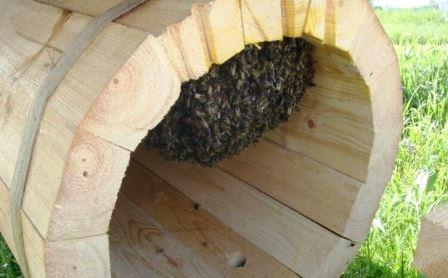
Some time ago, Mr. Heidinger realized that standard rectangular frames with sharp corners aren’t particularly natural for bees. In the wild, bees never build structures in this shape — it’s more convenient for beekeepers, not the insects. Due to these corners, bee colonies often struggle to maintain warmth inside the hive, which complicates their life.
It took Heidinger, from the town of Dachau, nearly ten years to design a round-shaped beehive, which he named «Bienenkugel», meaning «bee sphere». The hive was based on circular frames — the largest ones placed in the center, and the smallest near the edges.
According to Heidinger, a hive of this form is much warmer than standard rectangular ones, allowing bees to spend less honey maintaining a comfortable microclimate. Moreover, the round hive doesn’t accumulate condensation and therefore doesn’t develop mold. A stable temperature helps reduce drone brood and limits mite infestations. Heidinger also noticed that bees behave more calmly in a round hive and thus work more actively, gathering more honey.
Later, Heidinger improved his invention, giving it a cylindrical shape while keeping the round frames made of lignin, a «liquid wood» by-product of paper production. The cylindrical hive turned out to be more spacious while maintaining excellent thermal insulation properties.
To popularize his creation, Heidinger took part in developing a recreational zone in Dachau, on the site of a former landfill called Schinderkreppe. At the center of this park stands his cylindrical beehive, allowing visitors to observe the life of the bee colony inside up close.
It’s worth noting that a hive’s insulation qualities depend not only on its design but also on the materials used. Today, the most practical and comfortable option for bees is polyurethane (PPU) hives.
PPU hives from TM CraftOil — the best choice for modern apiaries
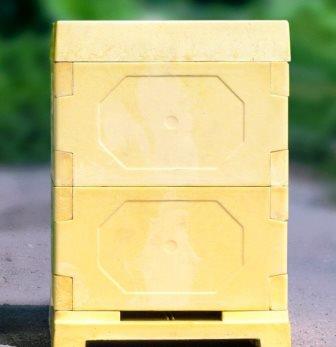
TM CraftOil, a Ukrainian producer of natural craft vegetable oils, also offers a wide range of high-quality beekeeping equipment. The catalog includes polymer beehives of various capacities, along with compatible frames, bodies and bottoms.
Among the most popular options are: PPU 10-frame hive, 300 mm, PPU 10-frame hive, 230 mm, PPU 10-frame hive, 145 mm.
These models are durable, easy to expand, and require minimal maintenance. They provide bees with comfortable living conditions — the hives don’t absorb moisture, don’t mold in high humidity, resist UV rays, and withstand temperature fluctuations.
Want to learn more about the advantages of our certified polymer hives or find out which model is best for your apiary? Our consultants will gladly help! Simply submit a request through our website to contact us or place an order.


